Gloucestershire Heritage Hub

Gloucestershire Archives

New staff, new social media, new deposits...

Numerous people have started their archive and heritage careers at Gloucestershire Archives through paid positions, volunteering tasks and/or work experience. Last September we were delighted to welcome two new members of staff to our Service.
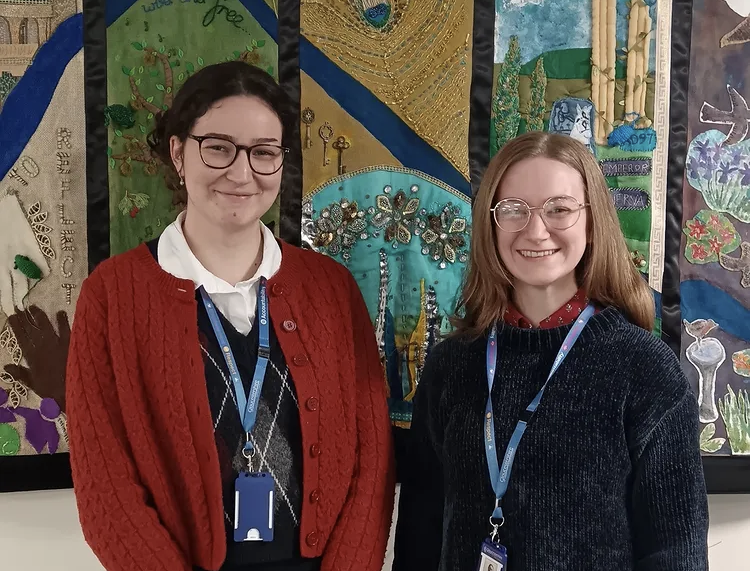
Ally Bartley (on the right) is based in the Access and Engagement Team and is also helping us with our communications.  She is the driving force behind our new and increasingly successful Instagram account. Please click here to subscribe.  

Niamh Devlin (on the left) is our Trainee Archivist and as well as being involved with research room duties, is learning how to accession and catalogue new deposits, broadening her experience so that she can undertake the post graduate archive administration qualification in the near future. Here she describes the collections she has been working on so far: 

Only 4 months into 2026, the Collections Management Team have already taken in over 150 accessions. As Trainee Archivist, I’ve worked with the team to process some of these accessions and I’d like to highlight a few stand-out collections which I’ve enjoyed working on.

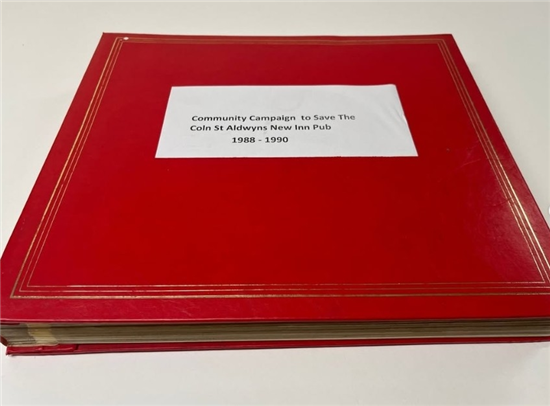
In March we received a photo album which contained photographs and newspaper cuttings of a campaign to save the Coln St Aldwyns village pub, The New Inn. This album is an excellent record of community spirit and successful village campaigning. When boxing the album, I used one of our “composite” boxes, ideal for when we have individual or small groups of records that will not fill up an entire box alone. We always try to maximise the space in our strong rooms. We’ve posted about the album on our Facebook and Instagram pages, where you can read more about the campaign and have a look at photographs in the album.
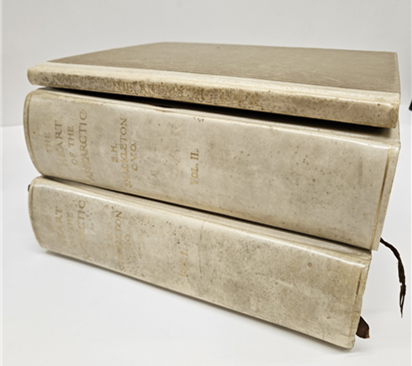
   

Another recent accession I’ve enjoyed cataloguing came from Tewkesbury Museum. They deposited three volumes which belonged to Raymond Priestly, who was born in Tewkesbury and joined various Antarctic expeditions. The volumes have been personalised by Priestley including photographs, illustrations, signatures and newspaper cuttings all relating to the expeditions he was a part of. I’ll be going into more detail in an upcoming Hub blog, which you can visit here

The album and volumes were particularly exciting to process. However, I’m now looking forward to working on new accessions including material from the Cotswold Savoyard group and the Women’s Institute. The wider team have been tackling larger parish collections, digital accessions including our recent all-staff photograph and photographic slides and glass plates of Gloucester and Tewkesbury.  As a result of this work, they'll soon be lots of new online catalogue entries for you to browse, order and enjoy.

Incoming accessions

We get new items every week added to our collections, coming from a wide variety of people and places across Gloucestershire. 

Earlier this year we received the papers of William Lionel Joyce Ford, who was a priest in the Church of England in the late-19th century and early-20th century, collection reference D17358. We received his ordination certificates as deacon and priest and a photograph of William. Parish records and documents relating to the church regularly come to the archive although the personal records of priests themselves aren’t usually included. It is especially satisfying to put a face to these documents, making them come to life.
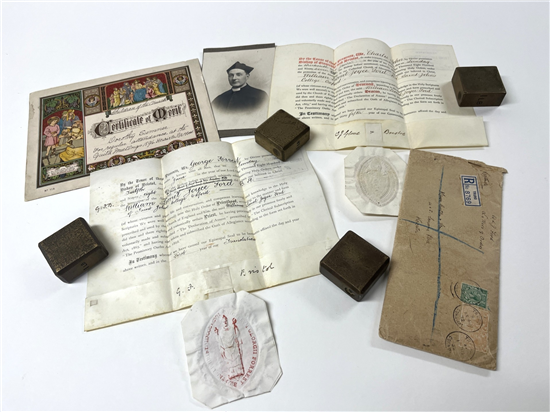
The collection also includes a certificate of merit for his wife Dorothy Sumner for attendance at Guild meetings. Dorothy was the daughter of Reginald Sumner, a solicitor and warden of St Mark’s Church, Gloucester. The documents were given to the archive by a descendant of William and Dorothy in January 2026.

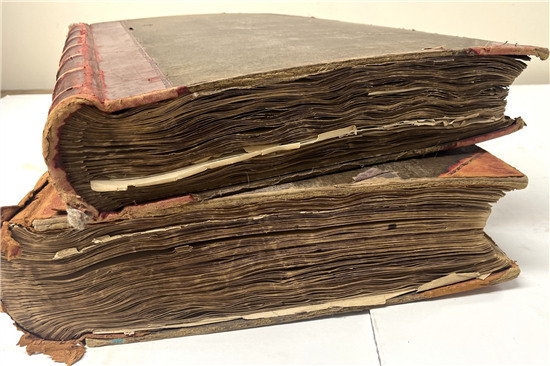
In addition to the many deposits for parishes, councils, businesses and families, we also get slightly unusual collections covering local events and topics. Earlier this year we received two volumes of election posters, collection reference D17417. They are from 1802 to 1919 and include newspaper cuttings and posters for local events. They cover Cirencester and the surrounding area in the most part but also have examples from Stroud and other districts of Gloucestershire.
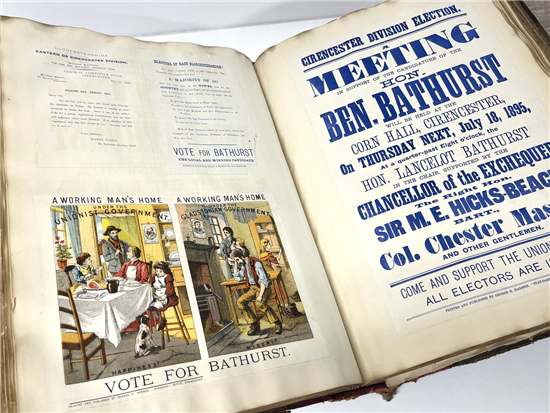
   

They are particularly interesting as they have been collated together so we can see how local politics developed across the area over time.  They also include some fascinating allegations made against opponents. They are also large, with dimensions of 53cm x 43cm x 12cm and 53cm x 42cm x 9cm. Having these posters together in two volumes is unusual and very useful for researching local history across the 19th and early 20th centuries. It makes it much easier to follow stories and campaigns and how they relate to events across the county and the country.
 

You are welcome to view either of the collections mentioned above in our public searchroom.  For information on making an appointment and registering for an ARA Archives card (our reader's pass) please see the Visit Us section on our website. Also, if you are interested in hearing more about new incoming material, we publish a blog about our accessions every month, available here

Local History

Lunatics, Cripples & Incurables: giving a talk at the Gloucester History Festival

I’ll be honest, this may have been one of the most exciting things to have happened to me. Ever. I love history, I’m passionate about accessibility, and I’m a big fan of the History Festival. The Triumvirate of Fabulousness!

I have spent the last couple of years looking through collections held at Gloucestershire Archives for documents relating to disability. It is an enormous umbrella term and covers any long term physical or mental health condition or illness. A massive 1 in 6 people are classed as disabled today, and yet there is surprisingly little history out there relating to this area.  

Most people with disabilities in the past got on with life as best as they could. When support was needed, it came from family and friends. But many of the Archives’ records were created when this wasn’t enough: we find a lot of information from education institutions, prisons, courts, mental asylums, workhouses and burial records. A lot of the information is ambiguous and frustratingly limited but personally, I think this adds to the joy of research. Plus, it echoes the way the lives of those with disabilities have been led, so often obscured or hidden from view.


As I arrived at the beautiful Blackfriars’ venue, donning my best yellow corduroy party pants, I was a little nervous. It wasn’t public speaking. It was whether anyone actually turned up. As I walked into the Scriptorium, I was delighted to find a room full of people. The next half an hour or so zoomed past and then it was all over. I’d done my best and I hoped, just hoped, that the history of disability might have been ever so slightly elevated.

My husband/chief cheerleader, Jamie, also thoroughly enjoyed himself. We went to a couple of superb talks and met Mary Beard.  We also got to use the Green Room and pocketed a couple of treacle tarts which we had with cream for our dinner.

Definitely one of my favourite ever experiences. Thanks to the Gloucester History Festival for having me and to everyone who came along to support.

Article written by Jemma Fowkes, Archives Assistant and Community Heritage Officer at Gloucester Archives

Family History

What might YOU find?

Running the Family History Centre within the Heritage Hub is a very important part of our ‘work’ (although we are all volunteers) and we always do our very best to help anyone who visits us whatever their interest and whether or not this relates specifically to Gloucestershire.  Some of the online sources in the Centre cover the whole world, so lots of scope!.

 These resources can lead us to some fascinating stories and into some quite unexpected places.  It is especially exciting when we’re researching a very ordinary person - the sort of individual who has almost vanished through the cracks of history.  And even better when we have a photograph of that person going about their normal business.

 You can imagine how pleased I was to come across this picture in the Cheltenham Chronicle & Gloucestershire Graphic for March 1910 and just how much I wanted to put a ‘name to the face’ - quite literally in this case since the poor man isn’t actually identified by name.  He appears in an article about Hartley Farm in Coberley and is described as the farm’s shepherd. 


So where to start?  I began with the 1911 census returns and struck lucky straightaway.  There was only one shepherd associated with Hartley Farm - he was living in a tied cottage so his (and his family’s) accommodation depended on his continued employment.  His name was Edwin Edwards, born in Chedworth in the early 1870s and living with his wife and three children. I also checked the Lloyd George Survey of Land Values made in 1909, available online glos1909survey.org.uk/ to find a bit more about Hartley Farm itself.  What I found really surprised me.  The Mills brothers: Edwin and Raymond were just tenants (not unusual) but the property itself was owned by Birmingham City Council - not quite what I’d expected.  With little prospect of owning Hartley Farm and with farming itself becoming less profitable, the Mills brothers cut their losses and emigrated to New Zealand in 1912.

 So did their shepherd go with them given the opportunities in New Zealand?  By June 1914, Edwin Edwards and his family were living in the Forest of Dean - his wife is buried in Bream churchyard - and in 1915 Edwin enlisted in the Gloucestershire Regiment in Cinderford.  His service records survive so we know that he didn’t have a ‘good’ war: he suffered from shellshock, was transferred to the Labour Corp then hospitalised in Scotland before being discharged as ‘unfit for service’ in early 1918.  He’d remarried in 1916. but it seems likely that this relationship wasn’t successful and the couple lived separately.

 In 1921, Edwin was a farm labourer living in Wales with his unemployed son and a housekeeper.  By 1934 he’d moved back to Northleach, married for a third time (not to his housekeeper) and died in 1941.  Not perhaps the life he’d expected back in 1910!

 Everyone and anyone is welcome to drop into the FH Centre to see what we can help them find or to join our regular online talks and live social events including a FH Fair on 7 November - just check our website here for more details.

Events

Events at the Heritage Hub

On Saturday 9th May you are welcome to join us for 'Strike' an afternoon of talks to celebrate the centenary of the General Strike, 1-4pm


On Saturday 6th June, in the month of the Football World Cup, we are investigating our local sporting heritage in Gloucester.  Robin Mogg, chairman of Gloucester City AFC, will be giving a talk on the history of the club and there will also be a document display of archives featuring all types of sport - football, rugby, bowls, tennis just to name a few. This event, titled 'We're having a ball...' will run between 1-3pm. 


On Saturday 4th July, we are hosting the event 'Heritage Matters'. Archives staff will be joined by conservators, museum curators, heritage volunteers, family history experts from the Gloucestershire Family History and Sue Webb, from Gloucestershire Police Archives. John Putley, Community Heritage Officer at Gloucestershire Archives will be talking about heritage crafts 'we used to do' and Karen Davidson, Berkeley Castle Archivist, will be discussing her work as an estate archivist illustrated by 15 significant documents. There will be 'behind the scenes' tours of Gloucestershire Archives strongrooms, demonstrations, 'name the object' activities and films throughout the event. And there will be an opportunity to taste cakes and biscuits made from recipes held in various collections at the Archives. The Heritage Hub garden will also be open so we have pre-ordered sunshine! It should be a fun afternoon. 

To book your place at any of these events please go to https://www.heritagehub.org.uk/events/ 

And if you can't make it in person, please remember to check out our online Secrets Revealed sessions using the same link above.  Alternatively take a look at the Gloucestershire Heritage Hub's YouTube channel or our growing bank of online exhibitions based on these talks here  


Events at John Moore Museum, Tewkesbury

The archive collection of John Moore of Tewkesbury, author, countryside campaigner and founding member of the Cheltenham Literary Festival is held at Gloucestershire Archives, catalogue reference D8451. In recent years, staff from the John Moore Museum in Tewkesbury have provided talks for the Heritage Hub's Saturday events and we have recently hosted a visit of the John Moore Society at Gloucestershire Archives. Therefore, we are happy to spread the word about their upcoming events: 

South Gloucestershire

William Champion's Gardens, Warmley.

When the weather starts to improves we are encouraged to explore interesting outdoor spaces with a heritage twist.

Close to the site of the Kingswood Heritage Museum are 'William Champion’s Gardens and Grottoes', a series of early 18th Century industrial pleasure gardens created between 1748-68 now tended by The Friends of William Champion’s Gardens.

A full history of the gardens is available here

The gardens are free to visit and open every day although the grottoes are only open from time to time, so please check for further details at www.williamchampionsgarden.org.uk before visiting.  A small car park is accessible via the entrance to Warmley House Care Home on Tower Road North, Warmley, BS30 8XN.

Gloucestershire Police Archives

All areas and ranks covered.

The talk and event season is upon us and this year we are going all over the historic county of Gloucestershire, from Mickleton in the north to Bradley Stoke in the south via Tutshill, Cirencester, Minchinhampton, Bishops Cleeve, Oakridge and South Cerney. Let’s hope the price of petrol comes down soon or we might have to resort to this method of transport.

.

The good thing about researching for talks is that it helps to expand our knowledge of the history of the Constabulary.  This season we have developed our knowledge about some of the early Superintendents. When the constabulary was formed the early officers were recorded in the Register of Rural Constabulary. This book is 50 cms high, 37 cms wide and 12 cms deep so you can imagine how heavy it is. You need 3 Shredded Wheat before even thinking about picking it up.


Of course, when I say that all the early officers are recorded in this book I mean just the Constables. Finding out about Superintendents who did not rise through the ranks is tricky. 

However, in the depths of the strongroom, I found an 1841 diary written by Superintendent Pilkington in the Chipping Campden area. We know from a newspaper cutting that he came over from Ireland with the First Chief Constable A.T. Lefroy in late 1839. We also know that he died in Cheltenham in 1844 at the age of 35.

The diary is a mine of information about the district that he covered, how far he went every day and who he met as well as his duties. It also tells us about the duties of the Constables, where they lived and served. We have many diaries like this, some very delicate but the sad thing is that we don’t have enough time to transcribe them all.

We are always on the lookout for information and photos. It is amazing what people have in their lofts.

If you have any police related photographs we are always happy to receive Jpegs via gloucestershirepolicearchives@gmail.com and queries can also be sent to the same email address. We are also able to scan photographs in our office at the Heritage Hub which is usually open Monday to Wednesday until 2.30pm but it is worth checking before you make a visit as we do go out and about quite often.

Taylorfitch. Bringing Newsletters to life